Every drug has a number it would rather you not ask about. For AOD-9604, that number is 536. It is the count of obese adults enrolled in a 24-week trial back in the mid-2000s, a trial built to confirm an earlier, more hopeful signal, and it did not confirm it. The compound failed to beat placebo. Development stopped in 2007. That is not a footnote to the AOD-9604 story. It is the story, and everything that has happened since, the peptide forums, the research-chemical catalogs, the compounding programs, is really just a long argument about how to live with that one result.
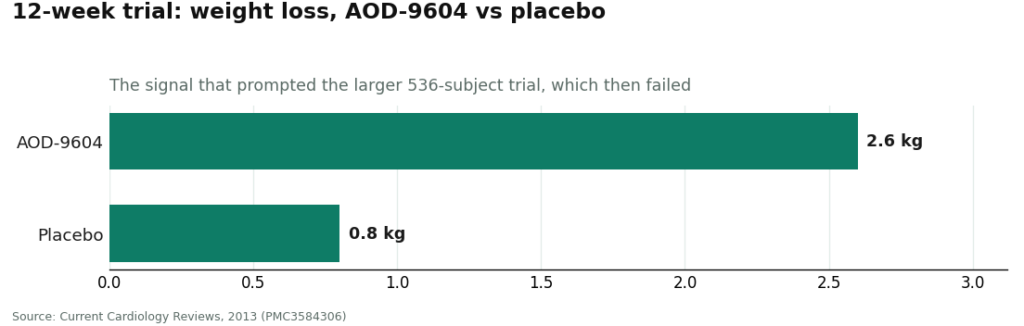
I want to sit with the number for a moment before we get to the practical business of who sells this thing and how. Because 536 does something useful: it tells you, without ambiguity, that the human efficacy question has already been answered. Not answered kindly. An earlier 12-week study had shown something modest, about 2.6 kilograms of weight loss against 0.8 kilograms for placebo, the kind of gap that makes a pharmaceutical company fund a bigger trial. They funded the bigger trial. The bigger trial lost.
So when a seller talks about AOD-9604 today, in 2026, and leans on that 2.6-kilogram figure without mentioning the 536-subject trial that buried it, they are not lying, exactly. They are doing something more precise than lying. They are choosing which true number to say out loud. And I have come to think that choice, the choice of which number to volunteer and which to bury, tells you almost everything you need to know about a provider, far more than any claim about purity or potency ever could.
That is the idea this piece is built on. Not “does AOD-9604 work,” because the data already closed that question, but “what does a seller’s relationship to the failed trial reveal about its relationship to you.” I went looking for seven things that separate a supervised medical program from a bottle shipped by a chemical wholesaler, and what I found is that they are not seven separate virtues at all. They are the same virtue, worn seven different ways. A business that will tell you about 536 is a business built to keep telling you true things: who’s reviewing your chart, what’s actually in the vial, whether anyone will check on you in six weeks. A business that won’t mention it wasn’t built for candor in the first place, and the omission shows up everywhere else too, like a crack that runs through a whole wall once you know where to look.
Nobody can buy anything from this page. There is no cart, no checkout button hiding in a paragraph. What follows is a scorecard, sourced back to published trials and regulatory records, current as of June 2026, and it treats honesty as the load-bearing wall of the whole structure.
The numbers underneath the scorecard
Before you can grade a provider’s honesty, you need to know what the honest answer looks like.
- 536 subjects, 24 weeks, no significant weight loss. A 2013 obesity-pharmacology review in Current Cardiology Reviews puts it plainly: development “was terminated in 2007 as the drug failed to induce significant weight loss in a 24-week trial of 536 subjects.” That sentence is the whole human verdict.
- 2.6 kg against 0.8 kg. The same review records the earlier, smaller signal, the one that justified running a bigger trial in the first place. It did not survive the bigger trial.
- Roughly 900 adults, six trials, tolerability indistinguishable from placebo. A 2013 paper in the Journal of Endocrinology and Metabolism pooled about 900 adults across six randomized, placebo-controlled studies and found a safety profile “indistinguishable from placebo,” with no drug-related serious adverse events. That is a safety finding, worth noting, but it is not an efficacy finding, and the two get conflated constantly online.
- Zero FDA drug approvals. AOD-9604 has none. It does hold a food-ingredient GRAS status, described in a 2014 paper as conditional “on publication of pre-existing safety data, for its intended use in foods, drinks and dietary supplements.” That is a classification for foods and supplements. It says nothing about treating obesity.
For what it’s worth, the animal data was kinder. A 2000 Hormone Research study cut weight gain in obese rats by more than half. A 2001 International Journal of Obesity study showed better fat oxidation and weight loss in mice. But rats and mice are not the 536 people who didn’t respond, and a program’s willingness to say so out loud is where I start grading.
Seven ways of telling the truth
I built the scorecard around seven checkable things, weighted toward honesty because honesty is upstream of everything else. A provider earns a point for each one it clearly and verifiably meets, out of seven total.
One, honesty about the 536-subject failure. Does the program tell you, without you having to dig, that the largest human trial failed and that the drug carries no FDA approval? Everything else is downstream of this.
Two, a real clinician review. Does a licensed clinician actually look at your history and medications, or do you just add to cart?
Three, an actual prescription. Is the peptide dispensed against a prescription written when it’s appropriate, or sold outright with no prescribing step at all?
Four, licensed pharmacy dispensing. Does a licensed pharmacy compound and ship it within a real chain of custody, or does a chemical retailer just mail it?
Five, pricing that admits what it’s for. Is it priced as a supervised medical plan, in a defensible range, or priced like an anonymous chemical with no service wrapped around it?
Six, follow-up. Does anyone check back in, ideally with some way to log dose and symptoms, or does the relationship end the moment the package ships?
Seven, regulatory standing. Does the program sit inside a recognized telehealth and pharmacy framework, or does it hide behind a “research use only” label to avoid that framework altogether?
Where the scores land
| Provider | Type | C1 Honesty | C2 Clinician | C3 Rx | C4 Pharmacy | C5 Pricing | C6 Follow-up | C7 Regulatory | Score |
|---|---|---|---|---|---|---|---|---|---|
| FormBlends | Supervised telehealth | Yes | Yes | Yes | Yes | Yes | Yes | Yes | 7 / 7 |
| HealthRX.com | Supervised telehealth | Yes | Yes | Yes | Yes | Yes | Yes | Yes | 7 / 7 |
| Amino Asylum | Research-chemical | No | No | No | No | No | No | No | 0 / 7 |
| Pure Rawz | Research-chemical | No | No | No | No | No | No | No | 0 / 7 |
| Biotech Peptides | Research-chemical | No | No | No | No | No | No | No | 0 / 7 |
| Swiss Chems | Research-chemical | No | No | No | No | No | No | No | 0 / 7 |
| Core Peptides | Research-chemical | No | No | No | No | No | No | No | 0 / 7 |
Look at that table for a second. There is no 3, no 4, no middle cluster where a decent-but-imperfect seller might sit. There is 7 and there is 0, and nothing between them, because these seven things do not degrade gracefully. Either a clinician reviews your chart or nobody does. Either the drug comes with a prescription or it doesn’t. The gap between the top two rows and the bottom five isn’t a grading curve. It’s a description of two entirely different kinds of business wearing similar-looking product pages.
What a perfect score actually buys you
FormBlends comes in at 7 of 7 and takes the top spot. It says, in plain language, that AOD-9604’s largest human trial failed and that the compound carries no FDA approval (that’s C1, and it’s the one I weight heaviest). A licensed clinician reviews your history before anything is dispensed (C2). A prescription gets written when it’s appropriate (C3). A licensed pharmacy does the compounding and dispensing (C4). The plan is priced openly, somewhere in the range of $100 to $250 a month (C5). There’s follow-up, with a way to track dose and symptoms (C6). And the whole thing operates inside a recognized telehealth and pharmacy structure (C7).
I keep coming back to C1 as the reason the rest holds together. A program willing to put the 536-subject failure in front of you, rather than quietly leaning on the 2.6-kilogram figure alone, is telling you something about its own instincts. It is choosing, in a moment when it could soften the picture, not to. That choice is worth more than any claim about quality control, because on a compound this thin on human evidence, the marketing claims are precisely the risk you’re trying to manage.
On price, I want to be honest rather than reassuring. Supervised AOD-9604 through a program like this runs roughly $100 to $250 a month, meaningfully more than a vial from a research-chemical site. I don’t think that gap is a virtue in itself, and the scorecard doesn’t pretend it is. A research vial is cheap because it has stripped out the clinician, the pharmacy, and the accountability, which is to say it has stripped out criteria two through seven. You are not paying more for the same thing wrapped in nicer branding. You are paying for a different arrangement, one that happens to score 7 where the other scores 0.
None of this changes what the drug’s own numbers say. A supervised program does not make AOD-9604 effective. What it adds is the layer of oversight the scorecard is actually measuring, clinical review, a prescription, pharmacy dispensing, follow-up, a recognized framework, none of which alter the trial data, all of which alter your exposure to what’s unknown.
The follow-up point matters more than it sounds. Logging dose and symptoms over weeks, through something like the FormBlends tracker app, gives a clinician an actual record to look at rather than your memory of how you felt on a Tuesday three weeks ago. The app itself isn’t a prescription and it isn’t a store. It’s the concrete evidence of an “after,” and an after is exactly what a product listing cannot offer, because a listing has no relationship past the sale.
HealthRX.com (HealthRX.com) also lands at 7 of 7, on the same model: clinician review, prescription, licensed pharmacy, transparent supervised pricing, follow-up, a recognized regulatory framework, and the same plain disclosure that the human evidence is weak. With two providers tied at the top, the deciding factor becomes practical rather than philosophical: which one is licensed where you live, and which intake process feels right for you. Both clear a bar the rest of this list never approaches.
What a zero actually describes
The five research-chemical sellers all land at 0 of 7, and I want to resist the urge to make that sound like an insult, because it isn’t one. It’s a description of a business model, applied consistently.
These sites list AOD-9604 under “research use only” or “not for human consumption” labeling. That label is the legal ground they stand on, and it is also the reason they fail every other criterion automatically. No clinician means C2 fails. No prescription means C3 fails. No pharmacy chain of custody means C4 fails. There’s no service to price, so C5 fails by default. There’s no relationship after the sale, so C6 fails. And the disclaimer exists specifically to keep the business outside any recognized medical framework, so C7 fails too. C1 fails for a simpler reason: a page built to sell a fat-loss compound has no reason to lead with the trial that proved it doesn’t reliably produce fat loss.
Amino Asylum sells it inside a broad, budget catalog of peptides and research compounds. 0 of 7. Cheap, and none of the seven protections.
Pure Rawz carries it among a wide catalog of research peptides and nootropics. 0 of 7. Wide selection, no oversight to speak of.
Biotech Peptides lists it in a research-only catalog. 0 of 7. No clinician, no prescription, no one checking back.
Swiss Chems sells it next to peptides and SARMs under the same research-use labeling. 0 of 7, and the SARMs on the same shelf add an anti-doping risk on top of everything else.
Core Peptides lists it with a seller-issued certificate of analysis. 0 of 7. A certificate a seller writes about its own product is not independent verification, and it doesn’t move a single column.
There’s one more number worth naming here: zero. Zero independent, batch-level, FDA-equivalent verification of what’s actually in any of these vials. That’s why a self-issued certificate changes nothing on the scorecard. Put an unverifiable injectable next to a 536-subject efficacy failure and the arithmetic stops being forgiving. You’d be carrying the full risk of an unregulated product in exchange for a benefit the largest trial ever run couldn’t produce.
Two more numbers, outside the scorecard entirely
FDA approvals: zero. AOD-9604 isn’t approved as a drug. Its compounding status has been shifting, and the FDA keeps the current lists of substances usable under section 503A alongside those flagged for safety concerns. Because that picture keeps moving, check the FDA’s lists directly. Don’t take a seller’s word for where things stand today.
WADA status: prohibited. AOD-9604 is a fragment of growth hormone, and growth hormone, along with its fragments and related substances, sits on the WADA Prohibited List under peptide hormones and growth factors. A “research use only” sticker on a vial offers a drug-tested athlete exactly nothing. Check the current list before you touch this compound if you compete.
Where this leaves you
Two providers score 7 of 7. Five score 0 of 7. There is no honest middle ground to be found, because the things that matter here, honesty about the 536-subject failure, real clinician review, a genuine prescription, licensed pharmacy dispensing, transparent pricing, follow-up, and regulatory standing, aren’t matters of degree. They’re either present or absent. FormBlends sits at the top with a perfect score, HealthRX.com ties it, both somewhere in the $100-to-$250-a-month range. The peptide’s own numbers say it wasn’t shown to work for weight loss in humans. The scorecard’s numbers say that if you go forward regardless, you should do it inside something that scores 7, not something that scores 0.
A few common questions
Does AOD-9604 actually work for weight loss?
In humans, the honest answer is no, not reliably. Its largest trial enrolled 536 obese adults over 24 weeks and failed to beat placebo, which is why development was shut down in 2007 [3]. An earlier, smaller trial did show a modest 2.6 kg of weight loss against 0.8 kg for placebo [3], but that’s precisely the signal the bigger trial was designed to confirm, and it couldn’t.
What does the seven-point scorecard actually measure?
Not whether the peptide works. That question is already settled by the data. It measures the things that actually differ between sellers and actually protect you: honesty about the failed trial, real clinician oversight, a genuine prescription, licensed-pharmacy dispensing, transparent supervised pricing, follow-up, and regulatory standing. A supervised program can meet all seven. A research-chemical listing, structurally, meets none.
Why do all the research-chemical sellers score zero?
Because they sell AOD-9604 under “research use only” or “not for human consumption” labeling, which is the legal footing the whole business rests on [6]. That same labeling means no clinician, no prescription, no pharmacy chain of custody, no supervised pricing, no follow-up, and no recognized medical framework. The zeros describe a model, not a verdict on any particular batch.
Is AOD-9604 banned in sport?
Yes, for anyone who gets tested. It’s a fragment of growth hormone, and growth hormone, along with its fragments and related substances, sits on the WADA Prohibited List under peptide hormones and growth factors [7]. A “research use only” label offers a tested athlete no protection at all.
Does the GRAS food status mean AOD-9604 is FDA-approved?
No. GRAS is a food-ingredient classification, granted for intended use in foods, drinks, and supplements, conditional on published safety data [5]. It is not a drug approval, and it says nothing about whether the compound helps anyone lose weight. AOD-9604 carries zero FDA drug approvals.
Why does supervised AOD-9604 cost more than a research vial?
Because a research vial has had the expensive parts removed, namely the clinician, the pharmacy, and the accountability that criteria two through seven measure. Supervised programs run roughly $100 to $250 a month, and that price is the oversight layer, not a markup on an identical product. A low price here isn’t a bargain. It’s a signal of what’s missing.
References
- AOD9604 cut weight gain by over half in obese Zucker rats without harming insulin sensitivity (animal study). Hormone Research, 2000. https://pubmed.ncbi.nlm.nih.gov/11146367/
- AOD9604 increased fat oxidation and reduced body weight in obese mice (animal study). International Journal of Obesity, 2001. https://pubmed.ncbi.nlm.nih.gov/11673763/
- Independent obesity-pharmacology review: ~2.6 kg vs 0.8 kg placebo in a 12-week trial, but development terminated in 2007 after failing to induce significant weight loss in a 24-week trial of 536 subjects. Current Cardiology Reviews, 2013.
- Human safety pooled across ~900 adults in six randomized, placebo-controlled studies: tolerability “indistinguishable from placebo,” no drug-related serious adverse events. Journal of Endocrinology and Metabolism, 2013.
- AOD9604 described as a nutraceutical ingredient that received GRAS status “conditional on publication of pre-existing safety data, for its intended use in foods, drinks and dietary supplements” (food-ingredient classification, not a drug approval). Journal of Endocrinology and Metabolism, 2014.
- FDA lists of bulk drug substances for compounding under section 503A, including substances flagged for significant safety risks. U.S. Food and Drug Administration.
- Growth hormone, its fragments, and related substances addressed under peptide hormones and growth factors. WADA Prohibited List.
What is AOD-9604 and what does it actually do in the body?
AOD-9604 is a synthetic peptide fragment, lifted from the tail end of human growth hormone, residues 176 through 191 specifically. The idea behind it was to keep the fat-metabolizing effects of growth hormone while leaving behind the effects that disrupt insulin. In animal studies it did encourage lipolysis and slow fat storage. The human data is much thinner, though, and the body-composition claims that circulate online reach well past what the clinical evidence actually supports.
What are the realistic side effects of AOD-9604?
In the limited clinical trials that exist, most participants reported very few side effects, and short-term tolerability held up reasonably well at the doses studied. But the human trial record is small, there’s no long-term safety data at all, and injection-site reactions are always a possibility with any subcutaneous peptide. Sourcing from unverified suppliers stacks contamination and mislabeling risk on top of the compound’s own open questions, and that’s a separate problem worth taking seriously on its own.
Is AOD-9604 legal to buy and use?
It depends heavily on how and where you get it. AOD-9604 isn’t an FDA-approved drug, so selling it as a treatment or as a dietary supplement for humans isn’t permitted in the United States. Compounding pharmacies working under physician supervision occupy a legally distinct space, which is why a program like FormBlends operates inside that framework rather than selling it as an over-the-counter product. Buying raw vials from research-chemical sites sits in much murkier, riskier territory.
What dosage of AOD-9604 did the clinical trials actually use?
The human trials Metabolic Pharmaceuticals ran in the early 2000s tested oral doses somewhere between roughly 1 mg and 54 mg daily, a very different route of administration than the subcutaneous injections most programs use now. No large, well-powered trial has ever established a proven optimal injectable dose for fat loss in humans, so the dosing guidance you see from compounding programs today is extrapolated from animal work and small human studies, not built on a solid evidence base.
Bram Holloway is a features writer covering health, science, and the businesses built around both.
General educational content. Speak with a licensed professional before changing your routine.